 +86-563-4308666

 Eng
Eng
 Español
 Français
Understanding the Importance of Ball Mill Liners
Ball mill liners are among the most critical components in grinding operations across mining, cement manufacturing, power generation, metallurgy, and chemical processing industries. While grinding media often receive significant attention, the liner system plays an equally important role in determining mill performance, grinding efficiency, energy consumption, and maintenance costs.
The primary purpose of a ball mill liner is to protect the mill shell from impact and abrasion caused by grinding media and processed materials. However, modern liners perform far more than a protective function. They influence grinding media movement, control impact energy, improve material flow, and directly affect grinding efficiency.
Selecting the right ball mill liner requires a thorough understanding of operating conditions, material characteristics, mill dimensions, and production objectives. A well-designed liner can significantly improve throughput while reducing wear rates and operational expenses. Conversely, an unsuitable liner may cause excessive energy consumption, poor grinding performance, and premature equipment failure.
How Ball Mill Liners Affect Grinding Efficiency
The liner design determines how grinding media move inside the rotating mill. During operation, liners lift grinding balls to a specific height before allowing them to cascade or cataract onto the material being processed. This movement generates the impact and abrasion forces necessary for particle size reduction.
Different liner profiles create different media trajectories. Some designs emphasize impact grinding for coarse particles, while others promote abrasive grinding for fine particle reduction. Selecting the correct liner profile ensures that the grinding mechanism aligns with the processing requirements.
An optimized liner design improves energy transfer from the mill to the grinding media. This results in better particle breakage efficiency, reduced over-grinding, and improved overall productivity.
Key Efficiency Benefits of Proper Liner Selection
- Improved grinding media motion.
- Higher throughput rates.
- Lower energy consumption per ton processed.
- Reduced liner and media wear.
- More consistent product particle size.
Common Types of Ball Mill Liners
Various liner designs are available to meet different grinding requirements. Understanding the characteristics of each type helps operators choose the most suitable solution.
| Liner Type | Main Feature | Typical Application |
| Wave Liner | Promotes cascading action | Fine grinding operations |
| Lifter Bar Liner | Creates strong media lifting | Coarse grinding |
| Step Liner | Controls ball movement | General-purpose milling |
| Classifying Liner | Separates media sizes | Cement mills |
| Rubber Liner | Lightweight and quiet | Secondary grinding |
| Composite Liner | Combines metal and rubber | High-performance mills |
Each liner design offers distinct advantages depending on the grinding environment and production goals.
Evaluating Material Characteristics Before Selection
The material being processed is one of the most important factors in liner selection. Ore hardness, abrasiveness, feed size, moisture content, and desired product fineness all influence liner performance.
Hard and highly abrasive materials require liners with superior wear resistance. In these applications, high-chromium alloy steel liners or specially engineered composite liners may provide the best balance between durability and grinding efficiency.
For softer materials, liner designs that maximize grinding efficiency may take precedence over extreme wear resistance. The objective is to optimize the relationship between material breakage and energy consumption.
Material Factors to Consider
- Material hardness.
- Abrasiveness.
- Feed particle size distribution.
- Required product fineness.
- Moisture and slurry characteristics.
Selecting the Right Liner Material
Liner material selection directly impacts wear life, maintenance frequency, and total operating costs. Modern ball mill liners are manufactured using various materials to meet different performance requirements.
Manganese Steel Liners
Manganese steel provides excellent impact resistance and work-hardening properties. It is commonly used in mills processing coarse feed materials where impact forces are high.
High-Chromium Alloy Liners
High-chromium alloy liners offer exceptional wear resistance. Their hard carbide structure makes them particularly suitable for abrasive grinding environments where liner longevity is a priority.
Rubber Liners
Rubber liners reduce noise levels and decrease overall mill weight. They also offer good resistance to corrosion and can simplify liner replacement procedures.
Composite Liners
Composite liners combine metal and rubber components to achieve both wear resistance and impact absorption. These systems have become increasingly popular in modern grinding circuits.
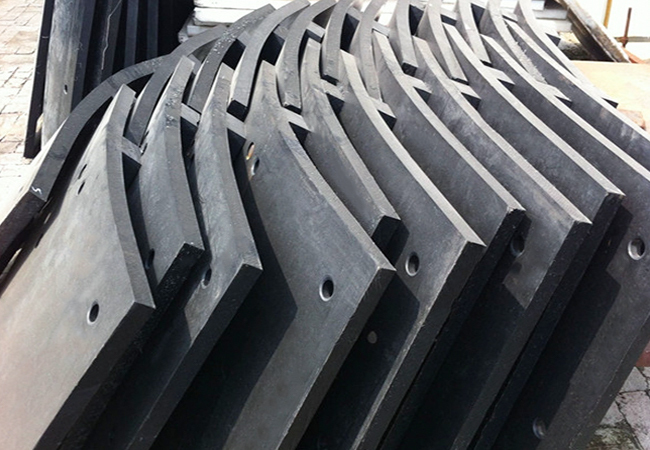
Matching Liner Profile to Grinding Objectives
The liner profile significantly affects grinding media trajectories. Selecting the correct profile requires understanding whether the grinding process relies primarily on impact breakage, abrasion, or a combination of both.
Coarse grinding applications often benefit from higher lifter bars that create strong cataracting motion. This increases impact energy and improves the breakage of larger particles.
Fine grinding operations typically require lower-profile liners that promote cascading motion. This encourages abrasion-based grinding and helps achieve finer particle sizes with greater energy efficiency.
Careful liner profile optimization can improve throughput without increasing mill power consumption.
Considering Mill Size and Operating Conditions
The dimensions and operating characteristics of the mill also influence liner selection. Larger mills generate greater impact forces and may require more robust liner designs.
Factors such as rotational speed, grinding media size, mill filling level, and throughput targets must be evaluated during the liner selection process.
A liner that performs well in one mill may not provide the same results in another because operating conditions vary significantly between installations.
| Operating Factor | Influence on Liner Selection |
| Mill Diameter | Determines impact energy levels |
| Mill Speed | Affects media trajectory |
| Media Size | Influences liner wear patterns |
| Feed Size | Determines impact requirements |
| Production Target | Affects profile optimization |
Balancing Wear Life and Grinding Performance
One common mistake is focusing exclusively on liner longevity. While extended wear life is important, it should not come at the expense of grinding efficiency.
A liner that lasts longer but reduces throughput may increase total production costs. Similarly, an aggressive liner profile that maximizes output but wears rapidly can result in excessive maintenance expenses.
The most effective liner selection strategy balances wear life, energy efficiency, throughput, and maintenance requirements. This holistic approach typically produces the lowest total cost of ownership.
Using Wear Analysis and Operational Data
Historical performance data can provide valuable insights when selecting new liners. Monitoring wear rates, power consumption, throughput, and product size distribution helps identify opportunities for improvement.
Advanced simulation tools are increasingly used to model grinding media movement and predict liner performance. These technologies allow engineers to evaluate different liner configurations before implementation.
Regular wear inspections also help operators determine whether current liner designs are delivering optimal performance or require modification.
Maintenance Considerations When Choosing Liners
Maintenance efficiency should be considered alongside grinding performance. Liners that are easier to install and replace can significantly reduce downtime during maintenance shutdowns.
Modern modular liner systems often simplify replacement procedures while improving worker safety. Reduced installation time allows mills to return to production more quickly, improving overall plant productivity.
Evaluating liner weight, fastening systems, and replacement intervals can help optimize maintenance planning and resource allocation.
Conclusion
Selecting the right ball mill liner is essential for achieving optimal mill efficiency, maximizing throughput, reducing energy consumption, and controlling operating costs. The ideal liner must be matched carefully to the mill design, material characteristics, grinding objectives, and maintenance requirements.
By evaluating liner material, profile design, wear resistance, operating conditions, and historical performance data, operators can make informed decisions that improve overall grinding performance. Rather than viewing liners solely as wear protection components, modern facilities recognize them as strategic tools for enhancing productivity and achieving long-term operational success.


