 +86-563-4308666

 Eng
Eng
 Español
 Français
Fundamental Metallurgy of Ultra-High Manganese Steel
Ultra-high manganese steel, often containing 12–14% manganese, is a metastable austenitic alloy known for its unique strain-hardening properties. Unlike conventional steel, it exhibits low initial hardness, typically around 200–250 HB, but increases in hardness under impact or compressive stress. The alloy's high manganese content stabilizes the austenitic structure at room temperature, preventing the formation of brittle martensite during normal operation. This stability allows the microstructure to adapt under repeated stress, forming dense dislocation networks that increase local hardness and toughness.
Mechanisms Behind Stress-Induced Hardening
The primary mechanism driving the increase in strength is strain-induced martensitic transformation, combined with work hardening. When the ball mill liner is subjected to repeated impacts from grinding media and ore particles, the following occurs:
- Plastic deformation generates dislocations within the austenitic matrix.
- Dislocation accumulation leads to local strain hardening, increasing resistance to further deformation.
- Under sufficient stress, localized martensite forms at high-strain zones, further enhancing hardness and wear resistance.
This combination of work hardening and transformation hardening is why ultra-high manganese steel liners become stronger as applied stress increases, particularly in areas exposed to repetitive impacts and abrasion.
Impact of Microstructure on Wear Resistance
The unique microstructure of UHMS (Ultra-High Manganese Steel) determines its wear-resistant performance. The initial soft austenitic matrix absorbs energy, reducing the risk of cracking during high-impact collisions. Over time, localized work hardening creates a hardened surface layer while retaining a ductile core. Key microstructural features include:
- Dense dislocation networks in the surface layer, increasing resistance to abrasive wear.
- Transformation zones where martensite formation adds hardness to high-stress areas.
- Uniform austenitic core that maintains toughness and prevents catastrophic failure under repeated loading.
This adaptive microstructure allows liners to exhibit self-strengthening properties, which is crucial for ball mills processing highly abrasive ores.
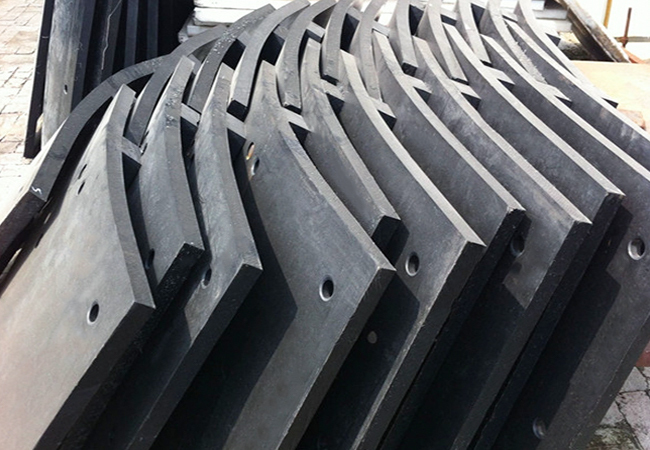
Industrial Applications in Ball Mills
Ultra-high manganese steel liners are extensively used in mining, cement, and mineral processing due to their ability to maintain integrity under high-impact conditions. Specific application scenarios include:
- Primary and secondary grinding mills handling hard ore with high silica content.
- High-throughput SAG mills, where impact and abrasion occur simultaneously.
- Cement ball mills, where liners must withstand repetitive impact from clinker without spalling or cracking.
The strain-hardening effect ensures that areas exposed to maximum stress increase in strength over time, resulting in longer service life and lower maintenance costs compared to conventional steel liners.
Factors Affecting Work Hardening in UHMS Liners
Several operational and material factors influence the rate and efficiency of stress-induced hardening in UHMS liners:
- Impact Frequency: Higher impact rates accelerate work hardening in the surface layer.
- Ore Hardness: Harder ores create more pronounced strain hardening due to increased local stress.
- Linertype Design: Corrugated or stepped liners focus stress in specific regions, promoting localized hardening where it is most needed.
- Temperature Effects: Elevated temperatures during milling may slightly reduce work hardening efficiency, but UHMS retains significant strain-hardening capability under operational ranges.
Comparison with Conventional Steel Liners
Unlike conventional chromium or low-alloy steel liners, UHMS exhibits increasing hardness under applied stress rather than remaining at a constant hardness. Conventional liners may crack or spall under repeated impact due to insufficient toughness, whereas UHMS adapts dynamically. The table below highlights key differences:
| Property | Conventional Steel | UHMS |
| Initial Hardness | 250–300 HB | 200–250 HB |
| Hardness After Stress | Remains similar or decreases due to cracking | 400–500 HB (surface layer) |
| Toughness | Moderate | High, maintains core ductility |
| Wear Resistance | Limited, prone to spalling | Increases under repeated impact |
Maintenance and Operational Considerations
To fully benefit from the strain-hardening properties of UHMS liners, operators should follow several best practices:
- Monitor mill load and impact frequency to ensure consistent hardening without overstressing the material.
- Inspect liner wear patterns regularly to determine optimal replacement timing and prevent localized failures.
- Use mixed liner profiles strategically to focus stress in areas where work hardening is desired, optimizing service life.
- Maintain proper grinding media size distribution to balance impact and abrasion across the liner surface.
Conclusion: The Engineering Advantage of UHMS Liners
Ultra-high manganese steel ball mill liners represent a paradigm shift in wear-resistant materials due to their unique strain-hardening capability. By increasing in strength as applied stress rises, these liners combine initial ductility with adaptive hardness, preventing premature failure and optimizing mill performance. Careful material selection, liner design, and operational monitoring ensure that the self-strengthening properties of UHMS are fully exploited, delivering longer service life, lower maintenance costs, and improved overall


