 +86-563-4308666

 Eng
Eng
 Español
 Français
Introduction to Ceramic Grinding Balls
Ceramic grinding balls are essential components in the material processing industry, primarily used in milling and grinding applications. Made from high-quality alumina, zirconia, or silicon carbide, these balls are highly durable, chemically resistant, and provide consistent performance across a variety of industrial processes. Understanding their practical uses can help industries optimize efficiency and improve product quality.
Properties That Make Ceramic Grinding Balls Ideal
The unique properties of ceramic grinding balls contribute directly to their widespread use in industrial processes. Their combination of hardness, wear resistance, and chemical stability makes them highly effective in grinding and milling operations.
Key Material Properties
- High hardness and mechanical strength for effective material grinding.
- Low wear rates, extending service life and reducing contamination.
- Chemical inertness, making them suitable for grinding corrosive or sensitive materials.
- Thermal stability that enables use in high-temperature milling processes.
Uses in Industrial Grinding and Milling
Ceramic grinding balls are widely used in industrial grinding mills, particularly in industries such as mining, cement, chemical, and pharmaceuticals. Their primary function is to reduce particle size, achieving uniform and fine powders for further processing or final products.
Applications in Different Industries
- Mining: Grinding ore into fine powders to extract valuable minerals efficiently.
- Cement Industry: Milling raw materials to create high-quality cement with consistent particle size.
- Chemical Processing: Producing powders for paints, pigments, and other chemical products.
- Pharmaceuticals: Ensuring fine, uniform particle sizes in medicinal powders.
Advantages Over Traditional Steel Grinding Media
Compared to traditional steel balls, ceramic grinding balls provide several key advantages that improve process efficiency and product quality.
Performance Benefits
- Lower wear rates reduce contamination from metal particles.
- Higher hardness maintains consistent grinding efficiency over time.
- Resistance to corrosion and oxidation extends service life in chemical environments.
- Lightweight ceramic balls reduce energy consumption in rotary mills.
Specific Uses in Mining and Metallurgy
In mining and metallurgy, ceramic grinding balls are used to grind hard ores into fine particles, enabling more efficient extraction of metals such as gold, copper, and iron. Their non-metallic nature prevents chemical contamination of sensitive minerals.
Practical Applications
- Grinding gold and silver ores to achieve optimal recovery rates.
- Reducing copper ore into fine powders for smelting processes.
- Processing rare earth minerals for high-purity applications.
- Minimizing contamination when grinding highly reactive ores.
Role in Cement and Construction Materials
Ceramic grinding balls are essential in the cement industry, where consistent particle size is critical for high-quality cement production. They provide uniform grinding without introducing metallic impurities that could affect cement properties.
Applications in Construction Material Processing
- Grinding limestone, clay, and other raw materials to create cement clinker.
- Ensuring uniform particle size in blended cement for improved strength and durability.
- Processing industrial minerals used in concrete additives.
Applications in the Chemical and Pharmaceutical Industries
Ceramic grinding balls are widely used for processing chemicals and pharmaceuticals due to their inertness, hardness, and precision in achieving fine particle sizes. They prevent contamination and maintain product purity.
Key Benefits for Chemicals and Pharmaceuticals
- Grinding pigments, dyes, and fine powders without chemical reactions.
- Maintaining high purity in pharmaceutical powders and active ingredients.
- Reducing particle size for better solubility and mixing efficiency.
- Enhancing surface area for chemical reactions in catalytic applications.
Size, Shape, and Material Variations
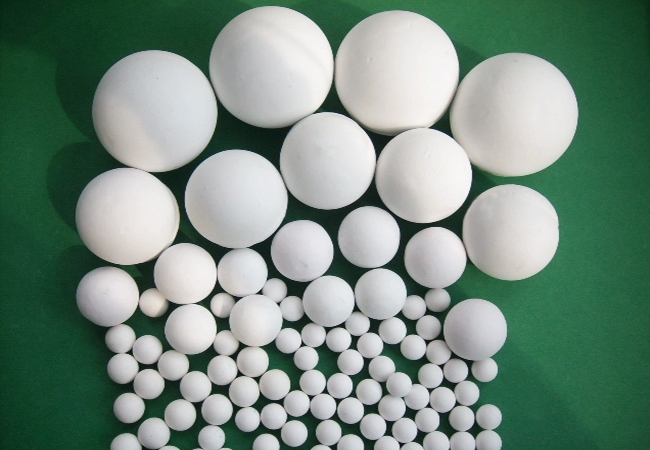
Ceramic grinding balls come in various sizes, shapes, and compositions, depending on the application. Proper selection of size and material ensures optimal grinding efficiency, reduced energy consumption, and consistent output.
Common Variations
- Alumina balls: High hardness, used for general milling and fine grinding.
- Zirconia balls: High density and toughness, suitable for ultra-fine grinding and precision applications.
- Silicon carbide balls: Extremely hard and resistant to wear, ideal for grinding hard materials like ores and metals.
- Various diameters ranging from 5 mm to 50 mm for different mill configurations.
Best Practices for Use and Maintenance
To maximize the performance of ceramic grinding balls, operators should follow best practices regarding loading, milling speed, and cleaning. Correct usage ensures consistent particle size, reduced contamination, and prolonged service life.
Operational Guidelines
- Pre-inspect balls for surface cracks or defects before loading into mills.
- Load the proper ball-to-material ratio for optimal grinding efficiency.
- Maintain appropriate mill speed to prevent ball damage and uneven grinding.
- Regularly remove worn or fractured balls to avoid contamination of final products.
- Clean balls and mills thoroughly between different material batches to maintain purity.
Conclusion
Ceramic grinding balls are versatile tools essential to many industrial processes, including mining, cement production, chemical manufacturing, and pharmaceuticals. Their unique properties—hardness, chemical resistance, and thermal stability—make them indispensable for efficient and high-quality material processing. Proper selection, usage, and maintenance ensure maximum performance, longevity, and product quality across various applications.


