 +86-563-4308666

 Eng
Eng
 Español
 Français
What Low-Chromium Alloy Cast Grinding Balls Are and Why They Matter
Low-chromium alloy cast grinding balls occupy a well-defined performance tier in the grinding media market — positioned above plain carbon steel balls and forged steel balls in terms of wear resistance and metallurgical consistency, while offering a significant cost advantage over high-chromium white iron alternatives. Typically containing between 1% and 3% chromium by mass along with controlled additions of manganese, silicon, and molybdenum, these balls are produced through precision casting processes that deliver a uniform microstructure across the entire ball cross-section — a characteristic that directly determines grinding performance and service life in ball mill applications.
The demand for low-chromium alloy cast grinding balls has grown consistently in cement production, mineral processing, power generation (coal grinding), and chemical processing, where grinding media consumption is a major recurring operating cost. In large-scale cement plants running continuous ball mills, grinding media costs can represent 40–60% of total grinding operating costs, making even modest improvements in ball service life economically significant at the fleet scale. Understanding the specific performance mechanisms that low-chromium alloy balls deliver is therefore directly relevant to procurement and operational decisions in these industries.
Wear Resistance Mechanisms: How Chromium Alloying Changes Grinding Ball Performance
The fundamental performance advantage of low-chromium alloy cast grinding balls over unalloyed cast iron or plain carbon steel alternatives lies in the microstructural changes that chromium addition produces during solidification and heat treatment. In an unalloyed cast iron ball, the wear surface consists of relatively soft pearlitic or ferritic matrix phases interspered with graphite, offering limited resistance to the abrasive and impact wear mechanisms active in ball mill grinding.
Chromium addition at the 1–3% level achieves several simultaneous microstructural benefits:
- Carbide refinement and distribution: Chromium promotes the formation of (Fe,Cr)₃C and M₇C₃ carbides within the matrix, which are significantly harder than the iron carbides present in unalloyed cast iron. These finely distributed carbides act as wear-resistant islands within the matrix, intercepting abrasive particles and reducing the rate of surface material removal.
- Matrix strengthening: Chromium in solid solution within the metallic matrix increases matrix hardness through solid-solution strengthening, raising the baseline resistance to micro-cutting and plastic deformation that characterize abrasive wear.
- Hardenability improvement: Chromium significantly improves the hardenability of the alloy, ensuring that quench heat treatment produces a fully hardened martensite or bainite structure throughout the ball cross-section rather than only at the surface. This through-hardening ensures that wear resistance does not degrade as the ball reduces in diameter through normal service life.
- Oxidation and corrosion resistance: Even at low addition levels, chromium improves the oxidation resistance of the ball surface, reducing the formation of loose, friable oxide scale that would otherwise accelerate wear in high-temperature or moist grinding environments.
The practical result of these mechanisms is that well-manufactured low-chromium alloy cast grinding balls typically exhibit surface hardness values of 45–55 HRC and volumetric wear rates 30–60% lower than equivalent-diameter plain cast iron balls in comparable grinding applications.
Impact Toughness: Resisting Fracture Under High-Energy Grinding Conditions
Wear resistance alone does not define grinding ball performance. In high-energy grinding operations — particularly in the first chamber of cement ball mills or in large-diameter SAG mill applications — grinding balls are subjected to repeated high-velocity impacts that generate stress waves through the ball cross-section. A grinding ball that is hard but insufficiently tough will fracture under these conditions, generating sharp fragments that damage mill liners, contaminate the ground product, and require unscheduled mill stoppages for fragment removal.
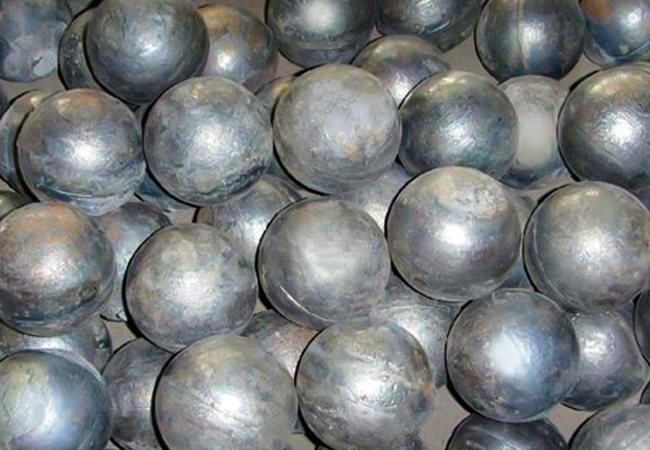
The composition and heat treatment of low-chromium alloy cast grinding balls are balanced to achieve a hardness-toughness combination that higher-chromium white iron balls cannot match at comparable cost. The lower chromium content, combined with careful control of carbon and manganese levels, produces a matrix that retains sufficient ductility to absorb impact energy without crack propagation, even at the hardness levels required for adequate abrasive wear resistance. The typical impact toughness value of a quality low-chromium alloy ball is 3–6 J/cm² — substantially higher than high-chromium white iron balls (1–2 J/cm²) while maintaining the hardness profile necessary for grinding duty.
Manufacturing quality control during the casting process plays a critical role in achieving this balance. Shrinkage porosity and segregation defects at the ball center — both of which are potential crack initiation sites under repeated impact loading — must be controlled through proper gating system design, pouring temperature management, and solidification rate control. Quality manufacturers subject production batches to destructive sectioning and metallographic examination to verify internal soundness before dispatch.
Roundness, Dimensional Consistency, and Their Effect on Mill Efficiency
A performance characteristic of low-chromium alloy cast grinding balls that is frequently overlooked in procurement decisions is dimensional consistency — the degree to which balls in a production batch conform to the specified diameter and sphericity. This parameter has a direct and quantifiable effect on grinding efficiency that operates independently of the balls' material properties.
Out-of-round or undersized balls create voids in the ball charge packing structure, reducing the effective grinding surface area per unit of mill volume and allowing coarser material to pass through without adequate size reduction. Batch-to-batch diameter variation causes unintended charge grading within the mill, disrupting the deliberate size distribution that mill operators use to optimize grinding stage efficiency. In cement mills, studies have demonstrated that charging balls with diameter variation exceeding ±2% of nominal size can reduce grinding efficiency by 3–7% relative to a well-graded charge — a penalty that accumulates continuously across thousands of operating hours.
The casting process used for low-chromium alloy balls, when properly controlled, delivers superior dimensional consistency compared to hammer-forged alternatives, where die wear and process variation can produce greater size scatter across a production run. Precision casting molds and automated pouring systems allow diameter tolerances of ±0.5–1.0mm to be maintained routinely at production scale.
Performance Comparison Across Common Grinding Media Types
To place low-chromium alloy cast grinding balls in context, the following comparison covers the principal performance parameters across the grinding media types most commonly evaluated in procurement decisions for cement and mineral processing applications:
| Media Type | Surface Hardness (HRC) | Impact Toughness | Relative Wear Rate | Relative Cost |
|---|---|---|---|---|
| Plain Cast Iron | 35–45 | Low | High (baseline) | Lowest |
| Low-Cr Alloy Cast (1–3% Cr) | 45–55 | Medium–High | 40–60% lower | Low–Medium |
| High-Cr White Iron (10–28% Cr) | 58–68 | Low | 70–85% lower | High |
| Forged Steel Ball | 50–60 | High | 50–65% lower | Medium–High |
Low-chromium alloy cast balls occupy a distinctly favorable position in this matrix for applications where moderate-to-high abrasive wear rates are the primary concern, impact loading is significant (ruling out brittle high-chromium white iron), and procurement economics demand a lower unit cost than premium forged or high-chromium cast alternatives.
Application Suitability and Selection Guidelines
Low-chromium alloy cast grinding balls deliver their best value-for-performance ratio in the following application contexts:
- Cement clinker grinding (first and second chamber): The combination of moderate hardness and impact resistance makes low-chromium balls well suited to both the coarse-grinding first chamber (where impact loading is highest) and the fine-grinding second chamber (where surface area wear dominates).
- Coal pulverization in power plants: Coal grinding generates relatively low impact forces but continuous abrasive wear. Low-chromium balls' enhanced wear resistance over plain iron significantly extends charge intervals in coal mill applications.
- Mineral processing (gold, copper, iron ore): In primary ball milling of hard sulfide or oxide ores, where both impact and abrasion components are significant, low-chromium balls provide reliable performance at a lower total cost of ownership than high-chromium alternatives.
- Chemical and industrial minerals grinding: Applications involving calcium carbonate, kaolin, feldspar, and similar abrasive industrial minerals benefit from the dimensional consistency and moderate hardness profile of low-chromium cast balls.
The selection of ball diameter within the low-chromium alloy category should follow established mill loading practice — larger balls (80–100mm) for coarse feed material with high Bond Work Index values, progressively smaller balls (40–60mm) for fine grinding stages. The superior hardenability of chromium-alloyed material ensures that through-hardness targets are achievable across the full commercial diameter range from 20mm to 150mm, eliminating the soft-core concern that limits the effective diameter range of plain cast iron media.


