 +86-563-4308666

 Eng
Eng
 Español
 Français
Ask ten mill superintendents what limits their grinding circuit, and most will eventually point to the same line item: the cost of replacing grinding media. Wear resistance technology is the discipline that decides how long a ball keeps its diameter, its shape and its grinding efficiency before the ore consumes it.
At ZXGB, we have spent years building cast and forged media for that exact problem. Our 60,000 square metre plant in Ningguo, Anhui, runs at an annual capacity of 50,000 tons, supported by a provincial research institute dedicated to steel balls and grinding media, and a technical team of 25 engineers and 32 specialists. Here is how we think about wear resistance: what controls it, how to compare media fairly, and which mill-side habits quietly destroy the wear life you paid for.
What Wear Resistance Really Means Inside a Mill
In a working mill, wear is not one event. It is three mechanisms running at the same time, and a ball has to survive all of them.
- Abrasion: hard ore particles slide and roll across the surface, gradually cutting metal away.
- Impact: repeated collisions chip edges, open surface cracks and, in severe cases, break the ball outright.
- Corrosion: wet pulp, dissolved oxygen and acidic or alkaline water attack the matrix between the carbides.
Because these mechanisms pull in different directions, wear resistance is always a balance. A very hard ball resists abrasion well but can fracture under heavy impact. A very tough ball survives impact but may grind away quickly. The engineering task is to find the point on that curve where your circuit spends the least money per ton of product.
Plants usually express the result as a specific wear rate: grams of media consumed per ton of ore milled, or kilograms of make-up balls per ton of product. That single figure contains the alloy, the heat treatment, the ball size, the mill speed and the ore itself, which is precisely why two suppliers can quote the same hardness and still deliver very different costs.
Alloy Chemistry Defines the Ceiling
Chromium is the backbone of cast media
In cast grinding balls, chromium decides how much hard carbide can form. As chromium rises above roughly 10 percent, the structure shifts toward hard M7C3 chromium carbides rather than softer M3C types. Those carbides act like a skeleton inside the matrix, so abrasion has to cut through them instead of simply pushing metal aside.
This is why the cast family is normally divided into four groups: low chrome for economical dry grinding, medium chrome for mixed duties, high chrome for cement clinker and hard ore, and ultra-high chrome for severe abrasion where long campaigns matter most. Each step up the chromium ladder buys wear life, but it also demands tighter process control to prevent the material from becoming brittle.
The matrix matters as much as the carbides
Carbides cannot protect a ball on their own; they need a hard, tough matrix to hold them in place. Manganese, molybdenum, copper and other elements are added to improve hardenability, so the ball hardens through its full section rather than only at the skin. A ball with excellent surface hardness but a soft core will deform and lose its profile under repeated impact.
For hard ore, clinker and slag duties, this is the family we usually suggest evaluating first:
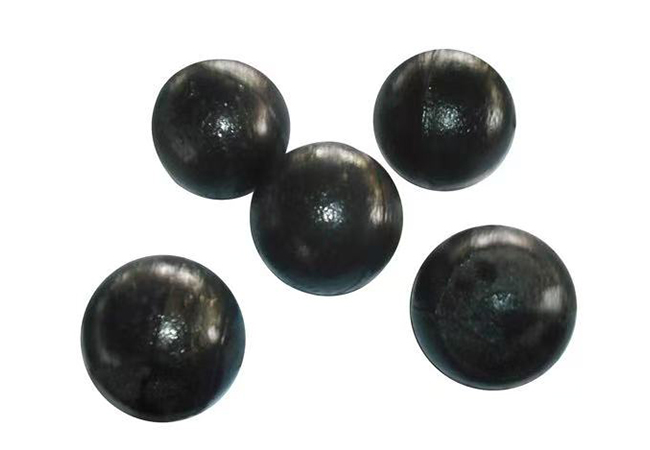 High Chrome Alloy Casting Ball Grinding BallIn today’s fast-paced industrial landscape, performance, durability and sustainability are no longer optional, but essential. That’s where our high-hardness, high-chro...View Product →
Heat Treatment Decides How Much of That Ceiling You Reach
Identical chemistry does not guarantee identical wear. Two balls poured from the same heat can leave the plant with noticeably different service lives if the heat treatment differs. Austenitizing temperature, holding time, quenching medium, quench speed and tempering temperature together decide the final microstructure.
For high-chrome media, we typically aim for a core hardness in the range of HRC 58 to 64, with a controlled level of retained austenite and a surface that has not been over-stressed by an aggressive quench. Quench too slowly and the carbides sit in a soft matrix that wears away quickly. Quench too violently and internal stresses build up, waiting for the first heavy impact to become a crack.
Why one hardness number is a weak buying criterion
A single hardness reading taken at one spot on one ball tells you very little about wear life. Ask instead for a hardness profile from surface to core, a description of the carbide structure, and a wear rate measured under conditions close to your own.
Comparing the Main Grinding Media Families
Selection gets easier when the options sit side by side. The table below summarises the families we produce and the duties they are normally matched to.
| Media family | Chromium content | Typical core hardness | Relative wear life | Best-fitted duty |
|---|---|---|---|---|
| Low-chrome cast ball | Up to about 3% | HRC 45 to 50 | Baseline | Dry grinding, light abrasion, cost-sensitive circuits |
| Medium-chrome cast ball | About 3% to 7% | HRC 48 to 55 | 1.3 to 1.8 times | Mixed ore, moderate impact, general milling |
| High-chrome cast ball | About 10% to 14% | HRC 58 to 64 | 2 to 3 times | Cement clinker, hard ore, wet milling |
| Ultra-high chrome cast ball | Above about 15% | HRC 60 to 65 | 2.5 to 4 times | Severe abrasion, fine grinding, long campaigns |
| Forged steel ball | Alloy steel, low chromium | HRC 55 to 62 | 1.5 to 3 times | Large-diameter primary milling, high impact |
| Ceramic ball | None | Very high surface hardness | 4 to 8 times in fine duty | Contamination-sensitive fine and ultra-fine grinding |
Read the table as a starting point. A medium-chrome ball in a soft ore circuit can outperform a high-chrome ball that is over-specified for the job, and a forged ball in a large primary mill often wins on impact toughness alone.
Process Control: Where Wear Resistance Is Manufactured
Casting and forging are two different roads to wear-resistant media, and each has its own quality levers. In casting, mould design, pouring temperature, inoculation and cooling rate determine how the carbides form and how evenly they distribute. In forging, bar quality, heating curve, deformation sequence and controlled cooling decide grain flow and toughness.
Our plant runs precision casting, forging and heat treatment as one integrated flow, with inspection from incoming raw material through to final packing under an ISO9001 quality system. We buy from long-term qualified steel and alloy suppliers, because an alloy design only means something if the chemistry reaching the furnace is the chemistry that was specified.
For primary mills that depend on large-diameter media and high impact toughness, forged media is usually the stronger answer:
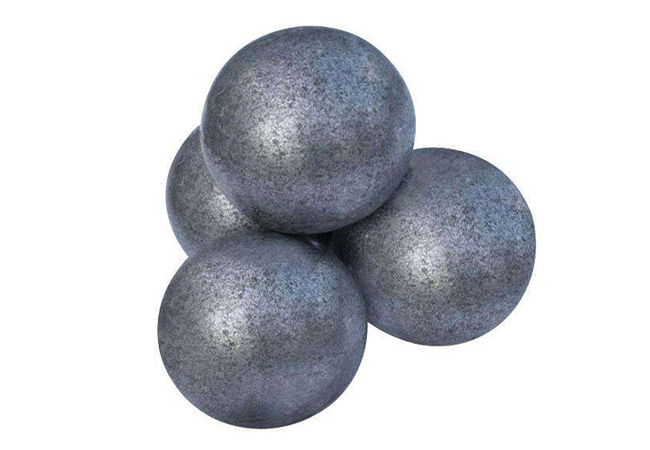 Forged Grinding BallsIn today’s industrial world, where efficiency, sustainability, and performance are key, precision forging has emerged as a game-changing manufacturing method—especiall...View Product →
The Mill Side of Wear Resistance
We have watched good balls fail within weeks because of how a mill was operated. Five variables explain most of the gap between laboratory results and plant reality.
- Ball size and charge mass: oversized balls add impact energy the ore does not need, raising both breakage and wear rates.
- Mill speed and charge motion: a cataracting charge delivers impact, while a cascading charge delivers abrasion. The right mode depends on feed size.
- Pulp density and chemistry: thin, acidic or heavily aerated slurry accelerates corrosion and erodes the matrix.
- Feed size distribution: a sudden rise in top size forces the media to do work they were never selected for.
- Liner condition: worn or polished liners reduce lift, and the charge begins sliding instead of tumbling.
The final point is easy to underestimate. Media and liners form one wear system, and changing liners without re-checking the ball charge, or the reverse, almost always costs more than it saves. Where impact loads are heavy, our ultra-high manganese steel liners are built to work alongside a forged charge:
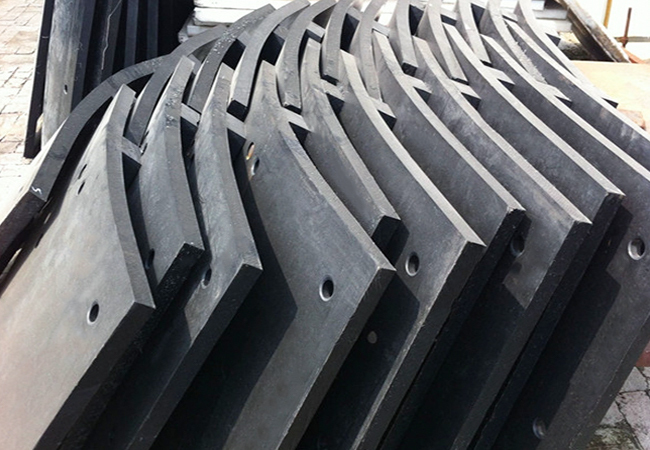 Ultra High Manganese Steel Lining Ball Mill LinerUltra-high manganese steel lining is a high-performance wear-resistant material component, mainly used in industrial equipment that withstands strong impact and severe...View Product →
How to Evaluate Wear Resistance Before You Commit
Because wear is a system property, the only fair comparison is cost per ton of ore milled. These steps keep that comparison honest.
- Ask for a specific wear rate under defined conditions, not a hardness figure alone.
- Request the hardness profile from surface to core, plus a description of the microstructure.
- Run a marked-ball test: add a weighed, tagged batch, recover it after a fixed period and measure the mass loss.
- Calculate the true cost per ton, including freight, make-up labour, downtime and any effect on throughput.
- Repeat the test whenever ore type, feed size or mill speed changes, because the best media today may not be the best next year.
Choose a Partner Who Engineers Wear Resistance
Every circuit has its own ore, its own mill geometry and its own definition of a good year. That is why we prefer to start with data rather than a catalogue page: a wear-rate history, a feed analysis, mill dimensions and a description of the duty are usually enough to narrow the choice to two or three candidates.
If you need a formulation, hardness profile or ball geometry matched to your application, our custom OEM wear-resistant solutions team can build it around your operating data. If you would rather talk it through first, contact our engineers and we will help you compare options against the numbers that matter in your plant.
Grinding ball wear resistance technology is not a specification that can be copied from a data sheet. It is the result of alloy design, disciplined heat treatment, honest inspection and a mill environment that allows good media to do their job. Align those four elements and the make-up ball rate stops being a monthly surprise.


