 +86-563-4308666

 Eng
Eng
 Español
 Français
A grinding mill that stops for an unplanned liner change loses hours of production, and those hours ripple straight through a plant's output targets. That is why ball mill liners deserve more attention at the purchasing stage than they usually get. A liner is a replaceable plate fixed to the inner surface of the mill shell and ends, yet it performs three jobs at the same time: it shields the shell from the constant impact and abrasion of grinding media and ore, it lifts the charge so energy is delivered into the material rather than wasted, and in many designs it helps sort the media so larger balls work the coarser feed. The short version for buyers: match the liner material to your impact conditions, match the profile to your media size and mill speed, and judge suppliers by casting quality and batch consistency rather than unit price. Those three decisions shape your cost per ton far more than the price tag on a single plate.
What a Ball Mill Liner Actually Does
A liner system is a wear part designed to be consumed; the shell it protects is not. Replacing a liner plate is a planned maintenance task, while repairing a worn-through mill shell is a capital event. Keeping that trade-off in mind clarifies every selection decision below.
Shell protection and rigidity
The liner takes the direct hits from balls as they drop, tumble, and roll through the charge. It also adds local stiffness to the shell plate, reducing flex and fatigue around bolted joints over years of service.
Energy transfer into the charge
The liner profile grips the charge and lifts the grinding media toward the shoulder of the mill. Where the balls release determines whether grinding happens by cascading, with balls rolling over one another and favoring fine grinding, or by cataracting, where media is thrown higher and breaks coarse particles by impact. A profile mismatched to mill speed and ball size either wastes power or chews through liners and media at the same time.
Media classification along the mill
Some geometries, commonly called classifying liners, progressively move larger balls toward the feed end and smaller ones toward the discharge. The result is a better match between ball size and particle size along the mill axis, which typically shows up as a tighter product size distribution and less over-grinding.
Liner Materials: Matching the Metal to the Wear
The first question worth answering bluntly: what is wearing the liner out faster, hitting or rubbing? Impact-dominated duties punish hard-but-brittle materials, while abrasion-dominated duties punish soft ones. Most material decisions follow from that single distinction.
| Liner Material | How It Behaves in Service | Best-Fitting Duty |
|---|---|---|
| Ordinary high manganese steel | Moderate initial hardness that builds a hardened surface layer through work hardening under repeated impact | Coarse grinding with large media and heavy impact loads |
| Ultra-high manganese steel | Higher manganese and alloy content deliver deeper, more stable hardening and better resistance to deformation | Large-diameter mills, heavier ball charges, severe impact |
| Medium and high chrome alloy castings | High heat-treated hardness resists sliding abrasion but tolerates less impact before cracking | Secondary and fine grinding where abrasion dominates |
| Rubber and composite liners | Elastic surface absorbs impact, cuts noise, and withstands corrosive slurries | Fine grinding, smaller media, corrosive applications |
Manganese steel remains the default for impact-heavy service. Its austenitic structure starts at a moderate hardness, roughly 200 HB, but every impact deforms the surface and builds a hard, wear-resistant layer while the core stays tough enough to absorb shock. That work-hardening behavior is exactly why it survives duty that would crack harder, more brittle alloys.
Where the mill runs at larger diameter or carries heavier ball charges, a standard manganese grade may harden too slowly or too shallowly to keep pace with the wear rate:
ordinary high manganese steel ball mill liner for standard impact duties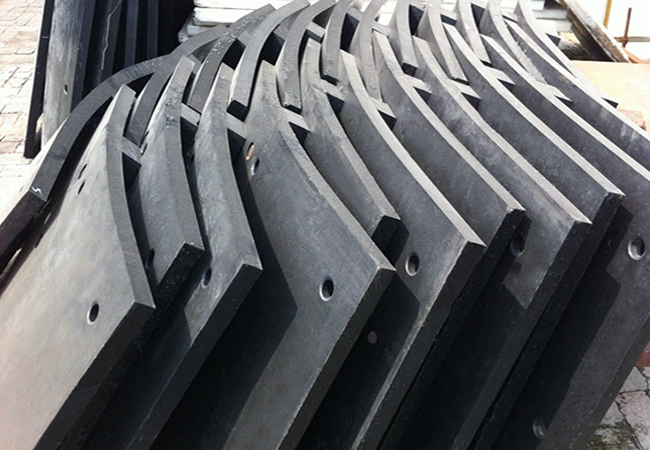 Ordinary High Manganese Steel Ball Mill LinerA work-hardening manganese steel liner for ball mills and crushers under heavy impact and wear. It suits large-diameter mills or heavier ball charges where slower-harden grades may not keep pace with wear.View Product →
The upgrade path raises manganese content and alloying so the hardened layer forms faster and deeper under the same operating load:
ultra-high manganese steel ball mill liner for heavy-impact mills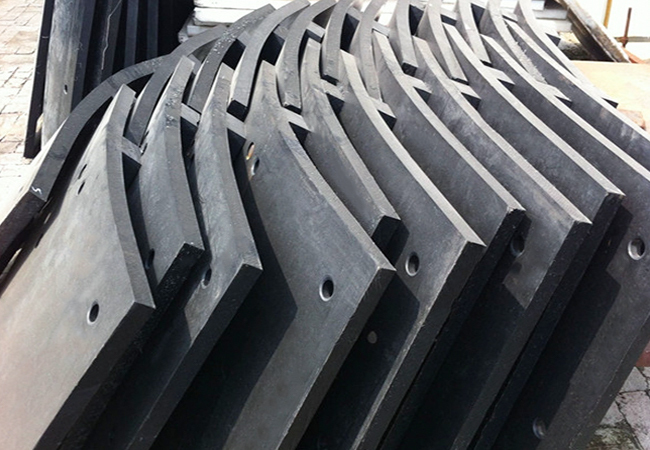 Ultra High Manganese Steel Ball Mill LinerAn upgraded liner with higher manganese content and multi-element alloying, forming a hardened layer faster and deeper under the same load, offering extended service life for large mining grinding and crushing equipment.View Product →
The mechanics behind that upgrade are worth understanding before you specify it. Once you know how ultra-high manganese steel strengthens under applied stress, choosing between grades stops being guesswork and becomes a calculation against your mill's impact energy.
Chrome alloy castings take the opposite approach: high initial hardness that shrugs off sliding abrasion, with less tolerance for severe impact. Rubber and composite liners round out the options for fine grinding and corrosive slurries, where elasticity and chemical resistance matter more than impact capacity.
Liner Profiles Shape How the Charge Moves
Material decides how long a liner lasts; profile decides what the mill does while it lasts. Each common profile shifts charge motion in a particular direction:
- Single and double wave liners: the general-purpose choice, balancing lift against wear life across a wide range of duties.
- Stepped liners: pronounced steps lift the charge harder, suited to coarse feed that needs more impact breakage.
- Wedge and corrugated liners: a middle path, often specified where wave liners wear unevenly.
- Flat and smooth liners: minimal lifting, used in fine grinding or where media and mill speed already supply enough action.
- Classifying liners: asymmetric surfaces that sort media by size along the mill length.
The trade-offs are practical. Taller lifter faces raise impact energy but carry a higher risk of breakage at high mill speeds and wear away faster. Smoother profiles extend life and suit secondary grinding, yet at low charge levels they can let the media slip and waste power. End liners and head plates matter just as much, because worn end geometry changes material residence time in the same way worn shell liners change grinding action. Since every profile gradually wears out of shape, throughput and product size often drift between relinings, which is a strong argument for logging liner thickness at each shell position during every inspection.
Matching a Liner to a Specific Application
Liner selection is a system decision, not a catalogue pick. Before ordering a full set, work through these checks:
- Mill diameter and operating speed. Larger diameters and a higher percentage of critical speed increase impact energy, pushing the choice toward tougher materials and more conservative profiles.
- Maximum ball size. Large top-size media concentrates impact load on fewer contact points, so the liner needs a carefully balanced hardness-to-toughness ratio.
- Ore hardness and abrasiveness. Silica-rich, abrasive feeds favor harder working surfaces, while wet or sticky feeds may require geometry that resists packing between plates.
- Grinding stage. Primary and coarse duties justify impact-oriented manganese grades; secondary and regrind duties often favor harder or non-metallic surfaces instead.
- Installation quality. Even the best liner fails early if gaps between plates let material circulate behind them or if bolts are torqued unevenly, so insist on machined seating surfaces, matched bolt holes, and a defined installation sequence.
For a fuller walkthrough of this process, the guide on how to select the right ball mill liner breaks each decision down step by step.
Buying on Total Cost, Not Unit Price
Liner price is the smallest number in the equation. Downtime, change-out labor, and the cost of a premature failure dominate the math. Three supplier-side factors separate a good liner purchase from a bad one.
Casting integrity comes first. Internal shrinkage porosity, inclusions, or cold cracks can cut liner life in half long before the surface shows measurable wear. Suppliers who run their own precision casting and heat treatment, rather than trading castings sourced elsewhere, can control and inspect these risks at the source.
Dimensional accuracy comes second. Thickness variation, misaligned bolt holes, or a curvature that does not match the shell radius cause fitting gaps, loose plates, and material infiltration behind the liner. Consistent heat treatment also keeps distortion within assembly tolerances.
Traceability and capacity come third. A certified quality management system, batch-level inspection records, and enough production capacity to deliver complete matched sets on your relining schedule turn a one-time purchase into a predictable maintenance plan. That logic sits behind our own setup at ZXGB: ISO9001-certified full-process inspection from raw material to finished plate, in-house casting and heat treatment, and 50,000 tons of annual wear-resistant capacity backing scheduled resupply.
You can browse the complete ball mill liner range to compare grades and specifications in one place:
ball mill liner product rangeBall Mill Liner ManufacturersAn overview of the complete ball mill liner range from a manufacturer with in-house casting, heat treatment, and ISO9001-controlled quality, useful for comparing grades and tailoring liner specifications to your mill duty.View Product →The practical takeaway is to treat liners as a system component rather than a consumable bought at the lowest quote. Record wear rates by shell position, note the profile condition when a set comes out, and share that data with your supplier, since manufacturers with their own research capability can adjust chemistry, heat treatment, or profile geometry for your exact duty. Over a few relining cycles, that feedback loop is usually worth far more than any discount negotiated up front.


