 +86-563-4308666

 Eng
Eng
 Español
 Français
Ask five mill operators what size grinding ball they run, and you will get five confident answers that do not quite match. That is not stubbornness. Ball size is a balance between the feed coming in, the mill doing the work, and the product going out, and every circuit balances those three differently.
So here is the honest answer before we go into detail: most ball mills run media between 20 mm and 100 mm. The largest balls in the charge are sized to break the coarsest feed the mill will ever see, and the smallest balls do the fine grinding near the discharge end. If your feed is 12 mm at 80% passing, expect a top size around 80 to 90 mm. If you are regrinding to 30 microns, 20 to 30 mm balls are usually enough.
Everything below is how we get from that rough picture to a number you can actually order.
Typical Ball Sizes by Application
Before calculating anything, it helps to know where most circuits land. The ranges below come from the cement plants, metal mines and industrial mineral operations we deal with. Treat them as a starting point, not a specification.
| Duty | Typical feed (F80) | Common ball diameter | What the media is doing |
|---|---|---|---|
| Primary ore grinding | 12 to 25 mm | 60 to 100 mm | Breaking the coarsest particles quickly |
| Primary ball mill, closed circuit | 8 to 15 mm | 50 to 80 mm | The bulk of coarse size reduction |
| Secondary or regrind mill | 3 to 8 mm | 30 to 50 mm | Preparing flotation or leach feed |
| Cement finish mill | 1 to 5 mm clinker | 15 to 40 mm | Grinding to 3,000 to 4,000 Blaine |
| Fine grinding to 30 microns | Under 1 mm | 20 to 30 mm | Final reduction with low breakage risk |
| Laboratory or pilot mill | Under 1 mm | 5 to 20 mm | Small-scale test work |
Two patterns are worth remembering. The top of the range is driven by feed size, and the bottom of the range is driven by the fineness you are chasing. When a plant tells us its grinding has turned erratic, one of those two ends is almost always the reason.
How to Calculate the Ball Size You Need
The industry standard is still Bond's method, which sizes the largest ball in the charge so that it can break the coarsest particle it will meet. It works from three inputs: the 80% passing size of the feed, the Bond work index of the ore, and the diameter of the mill.
A quick field estimate
For a rough number you can work out on the plant floor, take the square root of the F80 in millimetres and multiply it by 25. That gives you the largest ball diameter in millimetres:
- F80 of 2 mm gives a top size of roughly 35 mm
- F80 of 5 mm gives roughly 55 mm
- F80 of 12 mm gives roughly 85 mm
- F80 of 25 mm gives roughly 125 mm
That simple relationship tracks the published maximum ball size curves closely, which is why so many operators keep it in their head. It is still only a first estimate, because it says nothing about how hard your ore is or how big your mill is.
What the full calculation adds
The complete Bond equation folds in the work index and the mill diameter, along with a constant that reflects mill type and discharge arrangement. The direction of the correction matters more than the arithmetic: a bigger diameter mill lifts the charge higher and drops it harder, so it needs smaller balls than a small mill grinding the same feed. Harder ore needs larger balls. Finer product targets pull the required size down, not up.
Adjustments we usually apply
- High work index ore: step the calculated size up by 10 to 20 percent
- Target P80 below 40 microns: step down, and rarely go above 40 mm
- Mill diameter over 4 metres: drop one size step
- High mill speed or aggressive lifter bars: drop one size step
- Very fine, high value product: consider ceramic media rather than steel
One Size Is Never Enough: Ball Size Distribution
A charge made of one ball size grinds poorly, no matter how carefully that size was chosen. Grinding happens across a range of particle sizes, and each particle size is best broken by a particular ball diameter. Wear also shrinks your media continuously, so a working charge naturally contains a spread of sizes.
In practice, most plants only top up with the two or three largest sizes and let wear create everything smaller. A mill whose calculated top size is 80 mm might run a makeup blend of about half 80 mm, a third 60 mm and the rest 40 mm. Circuits that need a tight product size distribution sometimes add a fourth, smaller size to keep the fine end productive.
Check the charge every one to two months. If the average ball diameter in the mill has dropped well below your design range, you are effectively grinding with media that is two sizes too small, and no amount of extra power will fix the throughput.
Cast, Forged or Ceramic: What Changes the Size You Can Run
Ball size and ball material are linked. A ball that is too soft deforms and loses its roundness, which quietly changes the effective size of your media within a few weeks. A ball that is too hard and brittle breaks instead of wearing out. Here is how the three main media families fit into a sizing plan.
High chrome cast grinding balls
These are the workhorse for charges between roughly 20 mm and 100 mm. The high chromium content produces a hard, even structure, so the balls hold their diameter and their shape for a long time. That matters more than it sounds. If the media keep their size, the charge you designed stays the charge you are running, and your grind stays stable between top-ups. They suit cement finish mills, primary ore mills and regrind circuits where wear cost per ton of product is the number being watched. The full range is on our high chrome cast grinding balls page.
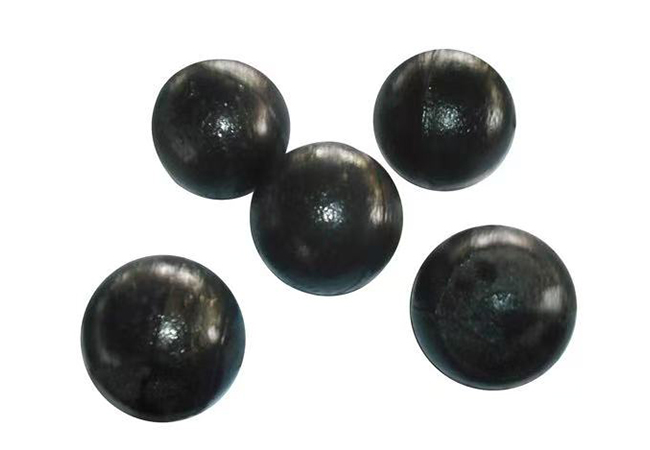 High Chrome Cast Grinding Balls ZQCr12High-chromium cast media in diameters up to 120 mm, offering ≥58 HRC hardness for stable grinding in cement, mining and regrind circuits.View Product →
Forged steel balls
Forged media come into their own when the top size climbs above about 100 mm, or when the mill delivers heavy impacts. The forged structure is tough and resists breakage under a big drop, which is why large primary and SAG circuits rely on it. The trade-off is wear: a forged ball typically wears faster than a high chrome ball of the same diameter, so the size distribution shifts more quickly and top-ups need to be more frequent. Many plants run forged media at the top of the charge and high chrome below it.
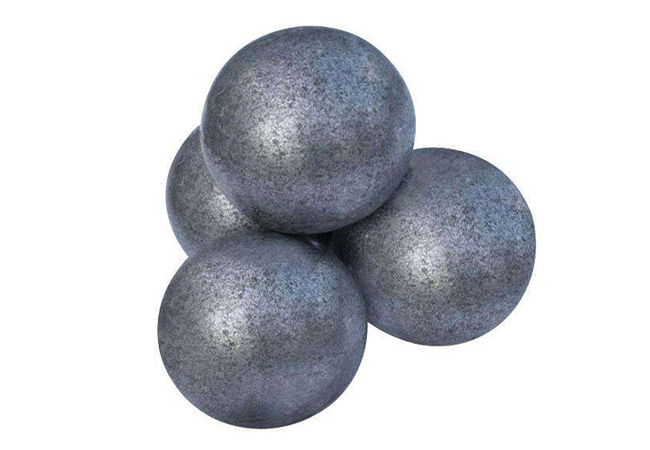 Precision Forged Grinding Balls for Ball MillsTough forged media for large primary and SAG circuits, where breakage resistance matters; available in diameters up to 120 mm.View Product →
Ceramic grinding balls
Once the required ball diameter falls below roughly 20 mm, steel becomes harder to justify. Small steel balls wear quickly and can contaminate the product. Ceramic media such as alumina and zirconia are chemically inert, hold their size well in fine and ultra-fine grinding, and work down to a few microns. The trade-off is density: ceramic weighs roughly half what steel does for the same diameter, so you may need to revisit mill speed or ball load when you switch. Our ceramic range covers the smaller end of the spectrum.
Signs Your Ball Size Is Wrong
The mill usually tells you before the lab does. Watch for these signals:
- Product gets coarser while power draw stays flat: the largest balls are too small for the feed
- Broken or flattened balls in the discharge: the top size is too large for the actual feed, or the material is too soft
- Over-grinding and sliming, with rising circulating load: media are too big for the target size
- Wear rate climbing in grams per ton of product: media are too soft, too small, or both
- Damage concentrated at the feed end of the mill liners: an oversized ball charge is hammering the shell
- Grind quality drifts within weeks of a top-up: the delivered hardness or size has changed
Test the Size Before You Commit to It
Calculation narrows the field; a trial settles it. A marked ball test is the cheapest way to get real answers. Weigh and mark a sample of balls, place them in the charge, run the mill normally for three to six weeks, then recover and reweigh them. That gives you a wear rate in grams per ton, and it tells you whether the balls are wearing evenly or breaking.
Run the new size in one mill while a sister mill stays on the old charge. Track specific energy consumption, P80, throughput and ball consumption side by side for at least a month. If the finer size is right, you should see the same or better throughput at lower specific energy, without a jump in breakage.
Sizing Balls With a Supplier Who Stays With You
Choosing a size is the easy part. Getting a supplier who can hold that diameter, that hardness and that chemistry batch after batch is what keeps a circuit stable year after year.
We make grinding media in Ningguo, Anhui, on a 60,000 square metre site with an annual capacity of 50,000 tons. Our technical team includes 25 engineers, and we run a provincial research institute dedicated to steel balls and grinding media, working alongside universities on new developments. Every batch passes through inspection from raw material to finished product under our ISO 9001 system, so the balls you receive in March behave like the balls you received in January.
If you send us your feed size, mill dimensions, work index and target grind, we will work through the sizing with you and recommend a starting charge rather than a guess.
Ball size is one of the few variables in a grinding circuit you can change on a Monday and see results from by Friday. Start with the feed size, check the calculation against your mill, step the number up or down for ore hardness, and confirm it with a trial. The number that survives that process is the right one for your plant.


