 +86-563-4308666

 Eng
Eng
 Español
 Français
Every grinding mill operator learns the same lesson sooner or later: the liner has more influence on the process than any other wear part. It protects the shell, but it also decides how the grinding media moves, how much energy the mill draws, and how long the mill can run between shutdowns. In short, the right liner saves money, and the wrong one costs money regardless of its purchase price. When people ask about the types of ball mill liners, the practical answer is best organized around two classification axes: material and profile. This article walks through both.
What a Ball Mill Liner Actually Does
A ball mill liner performs three jobs at the same time. It protects the mill shell from the impact and abrasion of the charge; it transfers energy to the grinding media, because the lift of the liner profile decides whether balls cascade, cataract, or slide; and it influences the classification and residence time of the material being ground.
These functions are interdependent, so liner selection is never a one-size-fits-all decision. At typical operating speeds of 65 to 80 percent of critical speed, the liner profile controls the trajectories of the grinding media. A profile that works well in a three-meter cement mill may perform poorly in a five-meter ball mill treating hard ore. Material and profile must be selected together, based on feed size, media size, mill speed, and the characteristics of the ore or clinker.
Types of Ball Mill Liners by Material
Liner materials fall into four families: manganese steel, chrome alloy steel, rubber, and ceramic. Mining and cement applications account for the largest share of demand, and the first two families dominate because they tolerate impact and abrasion at production scale.
Manganese Steel Liners
Manganese steel, also called Hadfield steel, contains roughly 12 to 14 percent manganese. Its defining characteristic is work hardening: the more the surface is struck, the harder it becomes, while the interior remains tough. This makes manganese steel the default choice for coarse primary grinding, where media of 75 to 125 mm strike the liner with high energy. Ordinary high manganese liners handle abrasive ores and large balls reliably and remain the most cost-effective option for many primary ball mills and SAG mills.
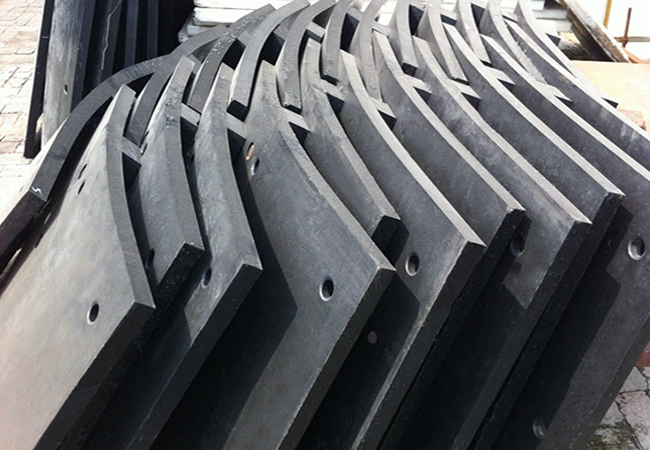 Ordinary High Manganese Steel Ball Mill LinerThis liner is the standard work-hardening option for primary ball and SAG mills, offering reliable wear resistance under high-energy impact from large grinding media at a cost-effective price.View Product →
Ultra-high manganese steel raises the manganese content to roughly 17 to 24 percent and accelerates the work-hardening response. The surface reaches a higher hardness under repeated impact, which extends liner life in severe duty such as large-diameter mills, high-speed operation, or very hard and coarse feeds. The trade-off is a higher alloy cost, so it is selected where the replacement interval and downtime cost dominate the decision.
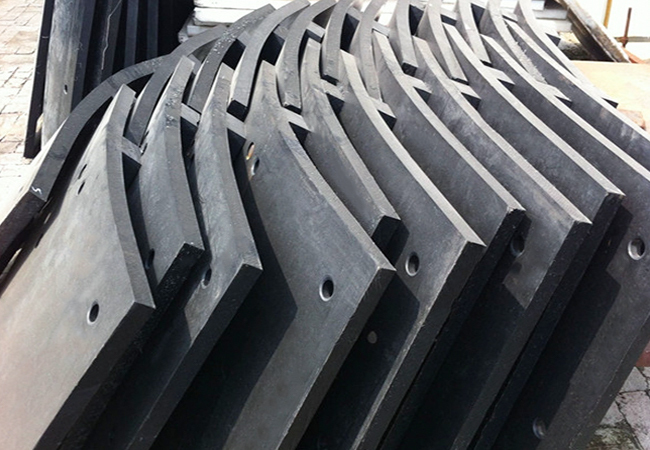 Ultra High Manganese Steel Ball Mill LinerWith 17–24% manganese and enhanced work-hardening, this upgraded liner suits severe duty like large-diameter mills, high-speed operation, and very hard or coarse feeds, extending service life.View Product →
High-Chrome Alloy Steel Liners
High-chrome alloy liners are heat treated to a typical hardness of 58 to 64 HRC. Chromium carbides in a tough matrix give them excellent sliding abrasion resistance, which makes them suitable for secondary and fine grinding where impact is moderate and wear by the slurry is the main mechanism. They are common in cement finish mills and regrind circuits. The limitation is reduced impact toughness: using high-chrome liners in a coarse primary mill with oversized balls risks cracking and premature failure.
Rubber Liners
Rubber liners weigh about one quarter as much as steel. They are easier and faster to install, reduce the load on mill bearings, absorb impact well, generate less noise, and resist corrosion in wet fine grinding. Rubber has a clear operating window, however: it is damaged by large media and coarse feed, so it is normally limited to secondary, regrind, and ultra-fine mills with moderate ball sizes.
Ceramic Liners
Alumina and zirconia ceramic liners are the hardest of the common liner materials and introduce no ferrous contamination, which matters in high-purity and fine grinding applications. They are brittle and practical mainly in small mills, attrition mills, and laboratory units.
| Material | Main Strength | Main Limitation | Best Application |
|---|---|---|---|
| Manganese steel | High impact toughness, work hardening | Moderate abrasion resistance at low impact | Primary grinding, large media |
| High-chrome alloy | Very high hardness, long wear life | Low impact tolerance, higher cost | Secondary and fine grinding |
| Rubber | Low weight, low noise, fast install | Poor with coarse feed and large media | Wet fine grinding and regrind |
| Ceramic | Extreme hardness, no ferrous contamination | Brittle, small size only | High-purity and ultra-fine grinding |
Types of Ball Mill Liners by Profile Shape
Profile shape controls the lift angle and therefore the motion of the charge. The same mill can change its grinding character simply by changing the liner profile.
Wave Liners
Wave liners use smooth repeating ridges that lift media moderately and encourage rolling and cascading. They produce efficient abrasion at lower impact stress, which makes them common in secondary and fine grinding circuits.
Step and Lorain Liners
Step liners, often called Lorain-style liners after their original design, combine a thick section, a step, and a thinner section. This geometry lifts the media higher and promotes cataracting, so it suits coarse grinding and large mills operating near the upper end of the speed range.
Wedge Liners
Wedge-shaped liners create a gradual lift and keep a thick cross section near the shell. They offer good shell protection and a controlled media trajectory, which is why they are widely used in large-diameter mills.
Flat and Grid Liners
Flat liners generate minimal lift and allow the media to slide rather than cascade; they are used in ultra-fine and tube mills where gentle grinding is required. Grid liners, with ribs or slots, retain and classify the media charge and appear mainly in dry grinding and special circuits.
| Profile | Lift Characteristic | Typical Use |
|---|---|---|
| Wave | Moderate lift, cascading | Secondary and fine grinding |
| Step (Lorain) | Strong lift, cataracting | Coarse grinding, high-speed mills |
| Wedge | Gradual lift, shell protection | Large-diameter mills |
| Flat | Minimal lift, sliding | Ultra-fine and tube mills |
| Grid | Media retention and classification | Dry grinding and special circuits |
How to Choose the Right Ball Mill Liner
Select the liner the way you select equipment: on total cost per ton, not on initial price. The cheapest liner is often the most expensive one to operate. Work through these factors in order:
- Mill diameter and speed. Large, high-speed mills need profiles with strong lift, such as step or wedge; small or slow mills can use simpler wave or flat shapes.
- Feed size and ore abrasiveness. Coarse, hard feed requires impact-tolerant manganese steel and a high-lift profile.
- Grinding media size. Media above 80 mm demand manganese liners; smaller media allow chrome alloy, rubber, or ceramic.
- Process conditions. Corrosive slurries favor rubber or chrome alloy; temperatures above about 80 °C exclude rubber.
- Liner thickness and wear allowance. Thicker liners last longer but reduce mill volume; balance wear life against throughput.
- Installation and downtime cost. Lighter or modular liners cut replacement time, which is frequently worth more than the liner price difference.
The liner and the grinding media wear as a system. In a secondary mill, oversized or poorly matched balls hammer the liner surface and shorten its life, while matched high-chrome grinding balls produce a more uniform charge and lower the impact load on the liner. Mills that buy liners and grinding media from the same source avoid compatibility problems and simplify quality control.
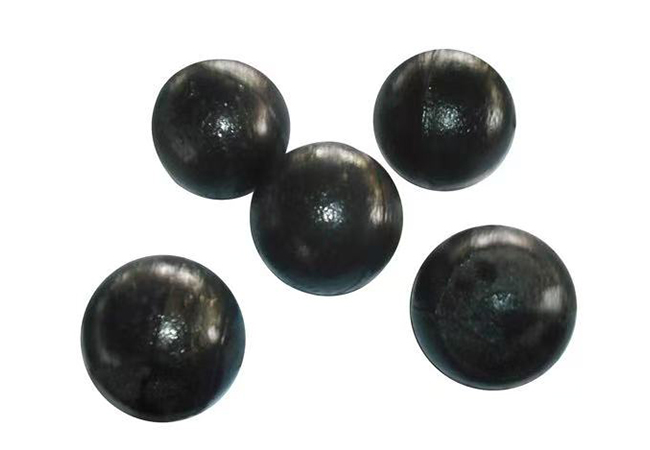 High Chrome Alloy Cast Grinding BallHeat-treated to 58–64 HRC, these grinding balls resist sliding abrasion in secondary and fine grinding circuits, with options customizable in size and chemistry for wet or aggressive environments.View Product →
Signs That Liner Replacement Is Due
Even the best liner is a consumable. Running it too long damages the mill shell and turns planned maintenance into emergency repair. Inspect weekly and schedule replacement when you see any of these signs:
- Measured liner thickness below 50 percent of original, or below the manufacturer's minimum.
- Bolt heads recessed into the liner, or leakage around bolts.
- Profiles visibly flattened, with lifting ribs worn smooth.
- Mill throughput falling while power draw stays high or rises.
- Cracked, loose, or missing segments and metallic noise during operation.
A simple inspection routine lets you replace liners during planned downtime, when the change costs hours instead of days of lost production.
Work with a Liner Supplier Who Understands the Whole Mill
The fastest way to avoid liner mistakes is to work with a manufacturer that makes the liner and knows how it interacts with the grinding media. ZXGB produces both manganese steel liners and the grinding balls that run against them, backed by ISO9001 quality management, a provincial research institute for steel balls and grinding media, and an annual capacity of 50,000 tons. The complete product range is on the mill liners and wear liners page. For a more detailed material-by-material comparison, our selection guide for longer liner life covers the practical trade-offs in more depth. If you want a recommendation for a specific mill, ZXGB engineers can review your operating data and propose a liner, profile, and media combination based on your feed and throughput target.


