 +86-563-4308666

 Eng
Eng
 Español
 Français
Imagine you have just completed a scheduled reline of a 20 MW ball mill in a copper concentrator. Forty days later, a broken liner plate stops the shell, and the crew spends eight hours removing the damaged plate, inspecting the shell, and starting up again. The root cause is later traced to a batch of liners with inconsistent manganese and carbon content from a low-cost foundry. That scenario is all too common when liner selection is based only on price.
The best way to avoid it is to choose a ball mill liner manufacturer that controls metallurgy from melt to heat treatment to final inspection under one quality system. This article explains what separates reliable manufacturers from unreliable ones and what questions to ask before you order.
What Makes a Ball Mill Liner Manufacturer Reliable?
Metallurgical Control and Alloy Chemistry
The liner is the part of the mill that absorbs the impact of the grinding balls and protects the shell. Most ball mills use austenitic manganese steel, which contains roughly 1.0–1.4% carbon and 11–14% manganese. When falling balls strike the liner surface, the steel work-hardens, becoming harder with each impact. But that hardening effect depends on a fully austenitic microstructure. If the material is not properly heat-treated, or if the alloy composition drifts, the liner can crack under impact instead of resisting it.
A capable liner manufacturer should publish its target alloy ranges and provide heat certificates for each batch. The manufacturer should also explain the difference between ordinary and ultra-high manganese steel grades. For typical abrasive conditions with moderate impact, ordinary high manganese steel liners are the proven choice. If your operation grinds very hard ore or runs at high energy density, ultra-high manganese steel liners work-harden more aggressively and may deliver longer life.
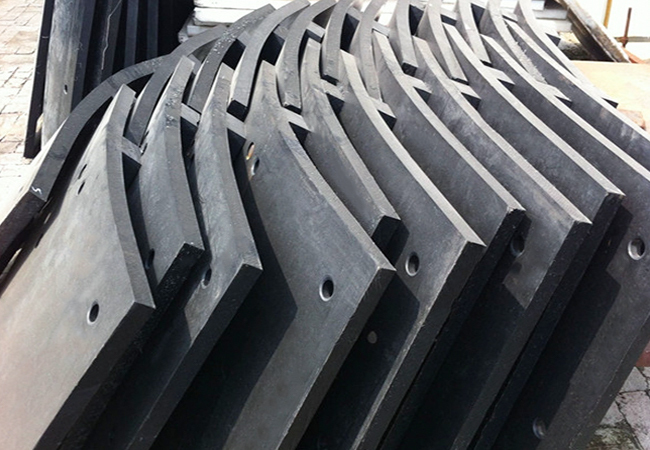 Ultra High Manganese Steel Lining Ball Mill Liner Suppliers, Custom Factory - NiAs China Ultra High Manganese Steel Lining Ball Mill Liner Suppliers and Custom Ultra High Manganese Steel Lining Ball Mill Liner Factory...View Product →
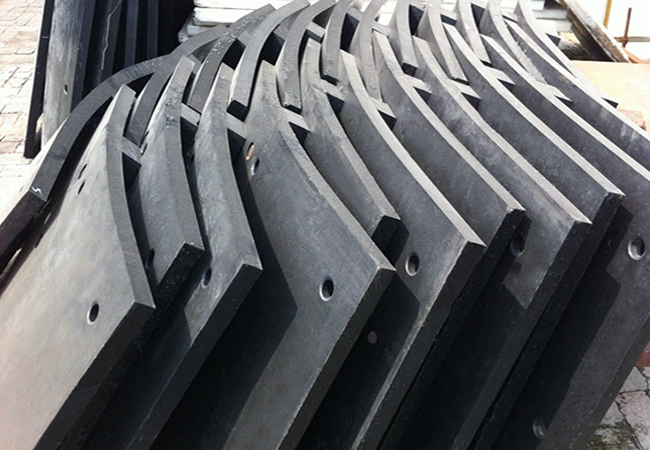 Ordinary High Manganese Steel Lining Ball Mill Liner Suppliers, Custom Factory -As China Ordinary High Manganese Steel Lining Ball Mill Liner Suppliers and Custom Ordinary High Manganese Steel Lining Ball Mill Liner F...View Product →
Production Capacity and Process Control
Capacity and process control determine batch consistency. A manufacturer with dedicated melting, heat treatment, and machining departments can produce liners that fit the shell and meet hardness targets every time. The melting operation must control pouring temperature, and the heat treatment line must be able to solution-anneal the castings at around 1050°C and quench them fast enough to keep carbides in solution.
A large production base also gives you scheduling flexibility. At our facility, the annual capacity is 50,000 tons, and the plant covers 60,000 square meters. We have 25 engineers and 32 technicians who support both standard products and custom liner designs. This engineering capacity is what allows a manufacturer to react quickly when your mill conditions change.
Quality Assurance and Traceability
ISO 9001 certification is the entry ticket, not the final proof. Ask for the manufacturer’s incoming inspection procedure, in-process inspection records, and final release certificates. The best suppliers will trace every liner back to its heat number, and they will tell you how they handle non-conforming material.
For manganese steel, a hardness number alone does not reveal whether the liner will work-harden in service. The microstructure matters. Ask the manufacturer what tests they run to confirm austenite content and carbide distribution. This is where an in-house metallurgical laboratory separates real manufacturers from traders.
Key Buying Factors When Choosing Ball Mill Liners Manufacturers
The right manufacturer is not always the one with the lowest quote. The table below summarizes the critical points to compare when you evaluate supplier proposals.
| Criteria | What to check | Why it matters |
|---|---|---|
| Alloy chemistry | Target ranges for Mn, C, Cr, and Mo; actual heat certificates | Inconsistent chemistry causes variable wear and cracking |
| Heat treatment | Solution annealing and water-quench records; hardness results | Correct austenitic structure is essential for work-hardening |
| Dimensional accuracy | Liner thickness, lifter height, bolt hole alignment | Poor fit creates liner movement, leaks, and early failure |
| Quality system | ISO 9001, inspection plan, traceability | A disciplined plant delivers repeatable products |
| Engineering support | Does the supplier help with liner profile design and relining advice? | Good support reduces downtime and raises grinding efficiency |
Compare Cost per Ton, Not Price per Ton
Procurement teams often compare liner suppliers on a price-per-ton basis. That can be misleading. Suppose liner A costs 5% less per ton but wears out 30% faster than liner B. The hidden costs are obvious: extra reline labor, more downtime, and a higher risk of shell damage the longer you run a worn liner. A more useful calculation is total cost per hour of operation, which includes liner price, downtime cost, and installation labor.
Technical Support and Liner Design
Liner design influences the ball trajectory. If the lifter profile is too high or the face angle is too steep, balls may be thrown against the shell rather than onto the ore bed. That wastes energy and accelerates liner wear. A serious manufacturer asks for your mill speed, diameter, ore type, feed size, and target product size before recommending a liner design. For a step-by-step selection method, read our guide on how to select the right ball mill liner.
Why the Right Manufacturer Matters for Mill Uptime
Unexpected liner failure is one of the most disruptive events in a grinding circuit. The mill must be stopped, the charge partially removed, and the shell area isolated for hot work. Even a short unplanned stop can cost more than the entire liner order. This is why reliability should weigh heavily in your choice of manufacturer.
Predictable wear life allows you to plan relines around other maintenance activities. A manufacturer with strong metallurgical research can also adjust the alloy for a specific mill. For instance, the R&D institute at our company works with universities to develop wear-resistant steel grades that match real impact conditions. The result is a liner that wears evenly and protects the shell longer.
How to Vet a Ball Mill Liner Manufacturer Before Ordering
Treat the first order as a qualification batch. Ask each short-listed manufacturer the following questions:
- Can you provide a material certificate for the exact heat used to produce our liners?
- What is your standard hardness range, and what test method do you use?
- What is the guaranteed minimum wear life under the specified operating conditions?
- Can you supply dimensional drawings of each liner for our pre-installation review?
- Do you offer a trial liner set at a discounted rate for validation?
- What references do you have for mills with a similar diameter and ore type?
Answers that come with actual data, rather than promises, indicate a supplier you can trust. If a manufacturer hesitates to share heat numbers or inspection records, that is a red flag.
Choosing a ball mill liner manufacturer is a strategic decision. Start with a supplier that controls alloy chemistry, applies proven heat treatment, keeps full traceability, and offers engineering support. That combination reduces unplanned downtime and lowers the total cost of grinding.
At our company, we produce liners and grinding media under one roof. You can review our full product range and production capabilities on our website, and we are ready to recommend a liner grade based on your mill specifications.


